
The Hopscotch Path of Grief
The Hopscotch Path of Grief
Living between loss-oriented and restoration-oriented life after the death of a loved one.
Sometimes grief is not only about missing someone.
Sometimes it is also about missing recognition.
The feeling that your sorrow does not fully fit within what is considered “normal.”
That your surroundings, often with loving intentions, do not quite know what to do with your grief.
And that meanwhile you try to continue living, while something essential has fallen away.
This tension forms the starting point of the research by Laura Rulo, Impact & Transition Facilitator.
Where this research began
Laura’s research did not arise from distance, but from lived experience.
At a young age, she lost her best friend, who was only 21 years old. The loss was profound, raw, and all-encompassing, and at the same time, she noticed how little space there was to truly carry this grief.
Not because people were indifferent, but because they could not place it. Because the loss of a best friend is not always seen as grief that is allowed to “count.” Because there is no fixed script for this kind of loss.
That experience, grieving without recognition, became the starting point of her research into what she describes as unacknowledged grief: grief that is not (sufficiently) seen, named, or recognized.
Grief does not ask for a solution, but for movement
A key insight from Laura’s research is that grief is not a straight line.
You do not move from sorrow to acceptance and then be done.
Grief moves.
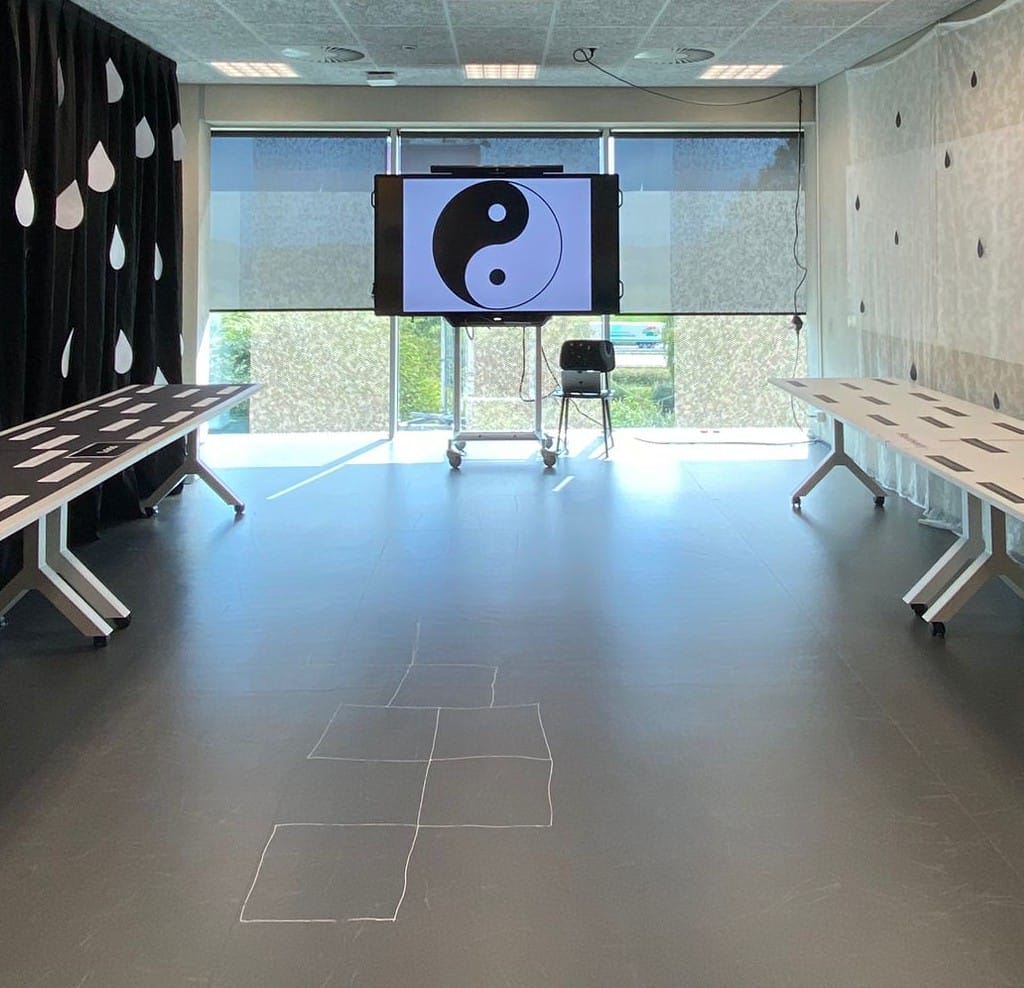
Like a hopscotch path.
You jump forward.
You stand still.
You lose your balance for a moment.
And sometimes you step back without intending to.
That is not failure.
That is grief
Loss-oriented
There are moments when you pause at what is no longer there.
At the absence.
The pain.
The longing.
The memory.
Moments when the loss is palpably present, sometimes without a clear trigger.
One sentence from Laura’s interviews captures this poignantly:
“The world keeps moving, while my world stood still for a moment.”
Restoration-oriented
And there are moments when you re-engage with life.
Moments when you long for lightness, rest, distraction, or renewed energy.
When you laugh, make plans, or simply breathe.
Not because the loss has disappeared, but because body and mind also need restoration.
And above all: the movement back and forth
Healthy grieving does not mean choosing between loss-orientation or restoration-orientation.
It means learning to shift.
At times you feel strong and forward-looking.
And suddenly a scent, a place, or a moment brings you back to the absence.
That is not a setback.
That is grief.
The exhibition Laura developed makes this movement literally visible.
The hopscotch path consists of statements from people in grief, words entrusted to her during conversations about loss. Combined with the balance between dark and light, the path invites not only understanding, but above all experience.
What happens when grief is not recognized
From the interviews in Laura’s research, it becomes clear how heavy grief becomes when it is not acknowledged. People begin to doubt themselves:
Am I allowed to feel this way?
Am I overreacting?
Shouldn’t I be “further along” by now?
That inner struggle costs energy.
And precisely because of this, the natural balance between loss and restoration is disrupted.
What people miss then is not explanation or advice, but a place where nothing has to be explained.
The strength of Laura’s work
The strength of this research lies not in answers, but in space. Space for grief to exist as it presents itself.
Without comparison.
Without timelines.
Without judgment.
The hopscotch path is not a model to follow, but an invitation to sense:
Where am I today?
A sense of kinship, not an explanation
What makes Laura’s work so powerful is that it invites slowing down and presence.
Not to analyze grief, but to take it seriously.
That same layer is also recognized within JM Holiday: in moments where conversation is not central, but experience is. Where space is created for what often has no words.
Not as a solution.
But as space and support.
In closing:
This blog does not aim to conclude. It aims to open something.
Those who walk the hopscotch path notice that each step feels different.
And that is exactly how grief works.
If you notice that you need something different, a moment for yourself, with rest, attention, and support? There is space for that at JM Holiday.
Without goals. Without pressure.